
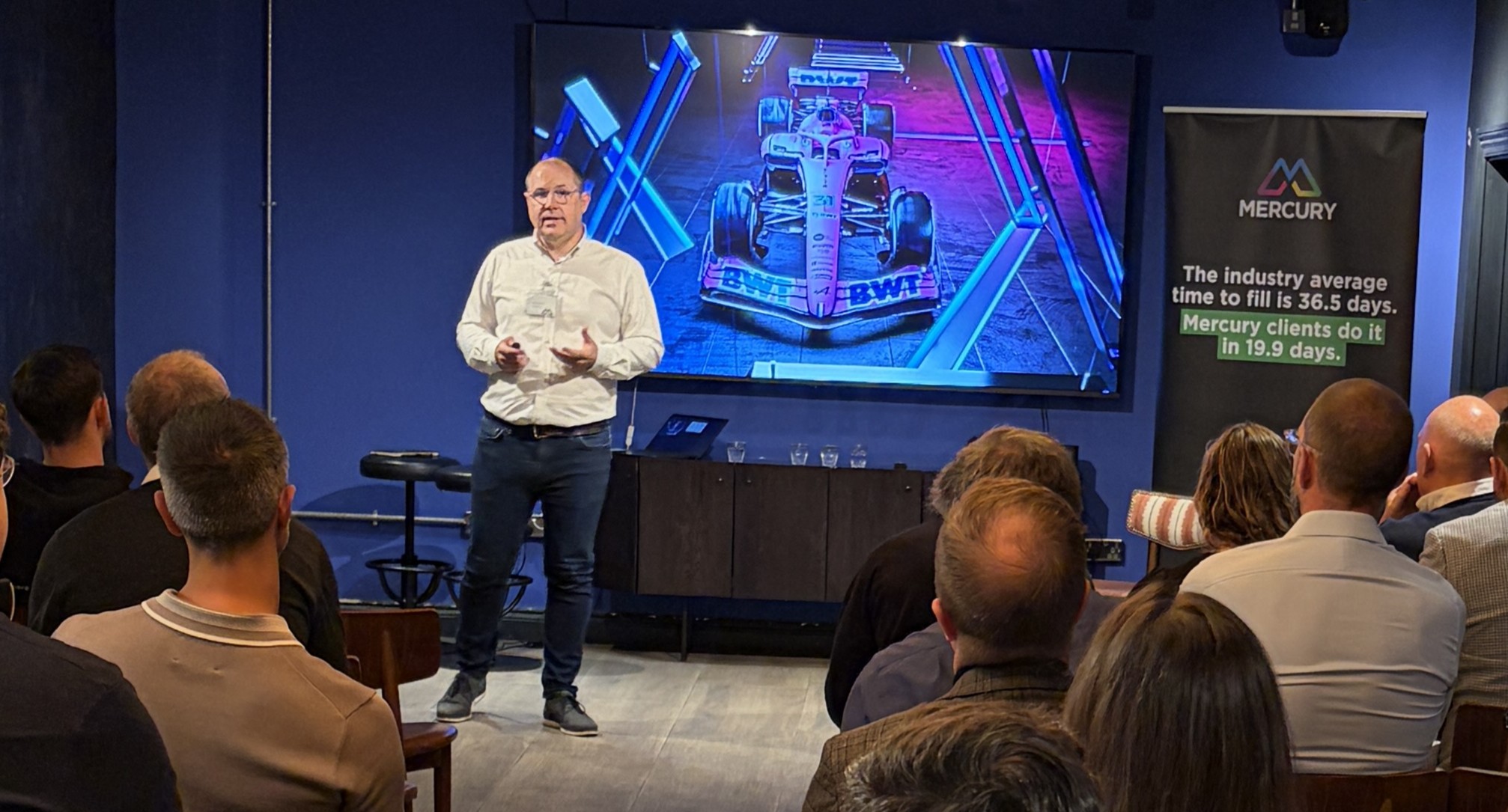


When recruitment leaders talk about technology, AI and automation, the conversation often starts with tools.
Perhaps it should start with data.
That was the overriding message from our recent recruitment data workshop in London, where industry experts from Mercury, DQ Global, Woo and Vente.ai explored one of the biggest challenges facing recruitment firms today: how to turn data into a competitive advantage.
While each speaker approached the topic from a different angle, a common theme emerged throughout the day:
Clean data enables better decisions. Enriched data creates opportunity. Operationalised data drives revenue.
Opening the session, Daniel Fox shared a story from a Microsoft event featuring the BWT Alpine Formula One team. Their challenge was understanding the vast amounts of data collected by their cars during a race,interpreting it, deciding what action to take, and then putting those insights back into operation in real time.
Recruitment firms face a similar challenge.
Most organisations already have data. The question is whether that data is accurate, enriched, accessible and actionable.
That led us to frame the day around three connected stages:
Each stage builds upon the last.
Conor from DQ Global focused on the first challenge: data quality.
His message was simple but powerful :Most recruitment firms view their CRM platform as the asset. In reality, the data inside it is often the most valuable asset the business owns.
The problem is that years of inconsistent data entry,duplicate records, incomplete information and poor standards create hidden operational challenges. Recruiters struggle to find the right people. Reporting becomes unreliable. AI produces questionable outputs.
Conor introduced the concept of the "Leaning Tower of Data". If the foundations are poor, everything built on top becomes increasingly unstable.
Bad data leads to bad reporting. Bad reporting leads to poor decisions.
Poor decisions become amplified when AI is added into the mix.
His recommendations were practical:
Perhaps the most important takeaway was that data quality should not be viewed as a one-off project. It is an ongoing discipline.
Once the foundations are in place, the next challenge is enrichment.
Gabe from Woo demonstrated how outdated data can undermine both recruiter productivity and AI adoption.
His argument was that many recruitment firms already possess valuable networks of candidates, clients and hiring managers. The problem is that those networks are often frozen in time.
A hiring manager who worked with you two years ago may now be leading a team somewhere else.
A candidate you placed may have been promoted and become a hiring manager themselves.
A second-place candidate who narrowly missed out on a role may now be the perfect fit for a new opportunity.
Without enriched and up-to-date data, those opportunities remain invisible.
Gabe highlighted an uncomfortable reality: many firms continue paying to source candidates externally when a large proportion of those individuals already exist in their CRM.
He also reinforced a point that resonated strongly throughout the day:
AI is only as good as the data it can access.
If data is inaccurate or outdated, trust in AI quickly disappears. If the data is current and enriched, AI becomes significantly more valuable.
The final session came from Cameron at Vente.ai, who focused on operationalising data for business development.
His presentation challenged some uncomfortable truths about recruitment sales activity.
Too many recruiters still give up after a single outreach attempt.
Too many firms invest heavily in data but fail to convert that information into meaningful conversations.
Cameron's view was that data should remove excuses.
Rather than asking recruiters to make generic cold calls,firms should provide context and signals:
When recruiters have clear reasons to contact a prospect,business development becomes easier, more relevant and more effective.
The objective is not simply to provide more data.
The objective is to provide better reasons to engage.
That shift from volume-based outreach to signal-based engagement represents a significant opportunity for recruitment firms looking to improve conversion rates and create more meaningful conversations.
One of the most interesting discussions during the panel session centered around AI and how many organisations are looking to AI as the answer.
The speakers broadly agreed that AI can create significant value, but only when built on strong foundations.
AI cannot magically solve poor data quality.
It cannot compensate for incomplete records.
It cannot reliably generate insights from inconsistent information.
What it can do is help organisations interpret data more effectively, uncover hidden opportunities, automate repetitive tasks and improve decision-making once the underlying data is trustworthy.
The workshop reinforced something many recruitment leaders already suspect.
The future of recruitment will not be determined by who buys the most technology.
It will be determined by who makes the best use of their data.
The firms that win will be the ones that:
Clean data.
Enriched data.
Operationalised data.
Get those three things right and everything else become seasier.