
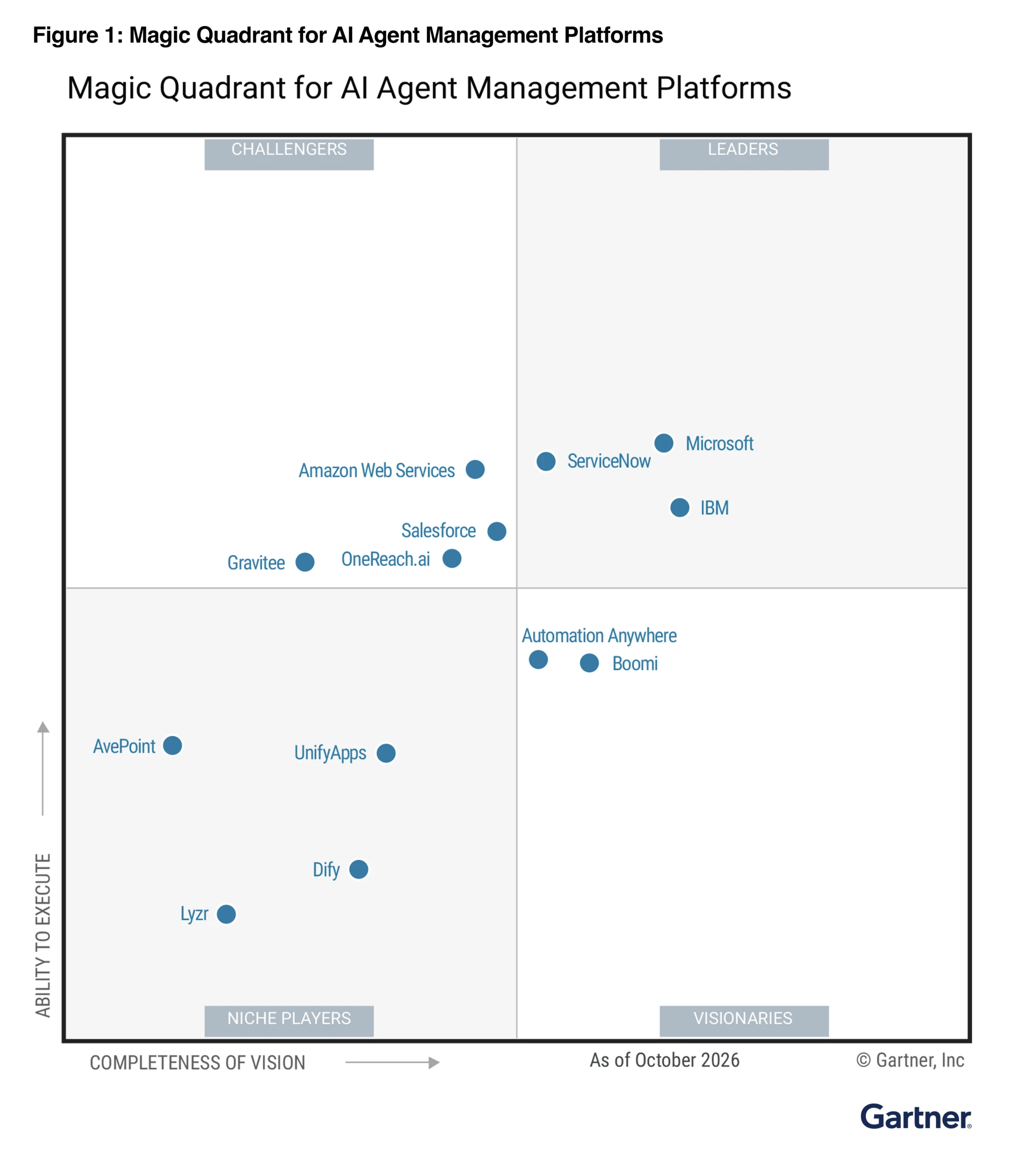
Microsoft's latest Gartner recognition for AI Agent Management Platforms.
On 3 November, Microsoft announced that it had been named a Leader in the inaugural 2026 Gartner Magic Quadrant for AI Agent Management Platforms.
While I’s great to know that Microsoft has been recognised as a Leader, it’s important to understand why Gartner is now evaluating this in the first place.
AI agent management has become a technology category in its own right
For recruitment and staffing businesses, we're moving beyond the question of what AI can do, towards something much more interesting. How do we manage an entire workforce of AI agents, and make sure they're delivering value?
From AI assistants to an AI workforce
Much of the conversation around AI in recruitment has focused on individual productivity. Writing job adverts, summarising interviews, drafting emails and searching for candidates. All valuable, and all capable of saving time. But these are largely examples of AI helping someone complete a task.
The next stage is different. Imagine agents that can screen applications, identify suitable candidates, monitor compliance requirements, chase outstanding timesheets, update records and proactively highlight opportunities - even carry out first-stage interviews. Not simply responding to prompts, but working across processes and taking action.
A recruitment business could eventually have dozens, potentially hundreds, of AI agents operating across its front, middle and back office.
And here's where things start getting complicated. Who owns those agents? What information can they access? Who decides what they're allowed to do? What happens when they get something wrong? And, perhaps most importantly, how do we know they're actually making the business better?
These are the commercial and operational questions that CEOs, COOs and IT leaders will increasingly need to answer together.
Why Microsoft's approach matters
Microsoft's recognition centres on its Agent 365 platform, which is designed to help organisations manage and govern AI agents. According to Microsoft, more than 50 million agents have already been registered within Agent 365. That's a substantial number, although registered agents shouldn't be confused with agents actively delivering measurable business value.
What interests me more is Microsoft's approach. Rather than creating an entirely separate management environment, Microsoft is extending technologies that many organisations already use, including Entra, Defender, Purview and Intune.
The principle is relatively straightforward. Just as businesses manage the identities, permissions and security of employees, they need to apply appropriate controls to their AI agents. Each agent should have an identity, an owner, a defined purpose and appropriate access rights.
Microsoft is also developing the ability to discover and manage agents built using other platforms, not just its own. That matters because the reality for most recruitment businesses is that their AI capability won't come from a single application. For example, they'll have AI within Mercury, Microsoft 365, specialist tools, and potentially applications they've developed themselves.
For recruitment leaders, the opportunity is bigger than productivity
I think there's a danger that we continue to measure AI's value in the wrong way. We get excited when somebody demonstrates that a task which previously took ten minutes can now be completed in thirty seconds. That's useful, but it's not necessarily a competitive advantage. After all, if every recruitment business has access to similar tools, everyone can achieve similar productivity improvements.
The real opportunity lies in applying AI to the things that make your business distinctive. Your processes, your expertise, your customer relationships and your data.
Consider a recruitment business with an established approach to identifying opportunities, managing candidates and delivering exceptional client service. What if AI agents could help execute those processes consistently, across every consultant, every team and every office?
A sourcing agent identifies candidates. A screening agent helps qualify them. Another prepares the consultant with relevant information. A compliance agent checks outstanding requirements. All working with the same underlying information, with appropriate controls and human oversight.
That's not simply about doing the same work faster. It's about building a more scalable, consistent and commercially effective and DIFFERENTIATED recruitment operation. And it makes the underlying technology architecture enormously important.
For IT leaders, the conversation is changing
For years, recruitment IT leaders have had to contend with disconnected applications, fragmented data, integration challenges and the security implications of increasingly complex technology estates. AI potentially makes all of those problems harder.
Every new agent could become another integration to manage, another set of permissions to control and another potential point of failure. Without a clear strategy, we risk recreating the fragmented technology environments that many businesses have spent years trying to simplify. Only this time, the applications won't just store and exchange information. They'll be making decisions and taking action. That's a very different risk profile.
It's why I believe recruitment IT leaders need to be thinking about three things.
First, architecture. Can your existing technology provide the connected data and processes that agents need to operate effectively? Or will every new AI capability require another complicated integration?
Second, governance. Can you establish who owns each agent, what it can access, what actions it can take and how its activity is audited? Sensitive candidate and client information makes this particularly important.
Third, commercial value. Can you measure what agents are achieving? Not simply how many have been deployed, but whether they're improving outcomes, reducing costs, increasing revenue or improving service delivery.
Interestingly, Microsoft says it's expanding Agent 365's capabilities around cost management and measuring the value agents deliver. For me, that's particularly important, because the objective shouldn't be to deploy the most AI agents. It should be to deploy the right agents, doing the right things, delivering measurable outcomes.
Your platform decisions today will shape your AI capabilities tomorrow
This is where I think recruitment leaders need to look beyond individual AI features when evaluating their technology investments. The conversation shouldn't simply be about which CRM or ATS has the most impressive AI demonstration. It should be about the platform underneath it.
Can it connect information across the business? Can it support the development of agents that reflect your own processes? Can it integrate with the tools your people already use? Can it provide the security and governance necessary to deploy AI confidently? And can it evolve as the technology changes?
At Mercury, our decision to build on Microsoft Dynamics 365 and Power Platform reflects precisely this philosophy. One connected Microsoft platform, supporting recruitment operations across the front, middle and back office, with the ability to extend and innovate using the wider Microsoft ecosystem.
As organisations increasingly introduce Copilot and AI agents into their operations, we believe that approach becomes even more valuable, because businesses need a foundation on which they can combine standard capabilities with the processes and innovations that make them different.
And ultimately, isn't that what good technology strategy should be about?
Read Micrsoft’s announcement here: Microsoft named a Leader in the 2026 Gartner Magic Quadrant for AI Agent Management Platforms, 3 November 2026.